
The business challenge
At Cencora, employees had software instruction for submitting expense reports, but no dedicated learning experience explaining how to apply the organization’s travel and entertainment expense policy. Expense submissions were being rejected, and employees needed clearer guidance on allowable spending, required documentation, limits, and approver responsibilities.
My starting point was a policy document of approximately 100 pages. I independently analyzed the source material, extracted the practical requirements employees needed, and deliberately kept the course focused on policy decisions rather than duplicating the existing software training.
My instructional strategy
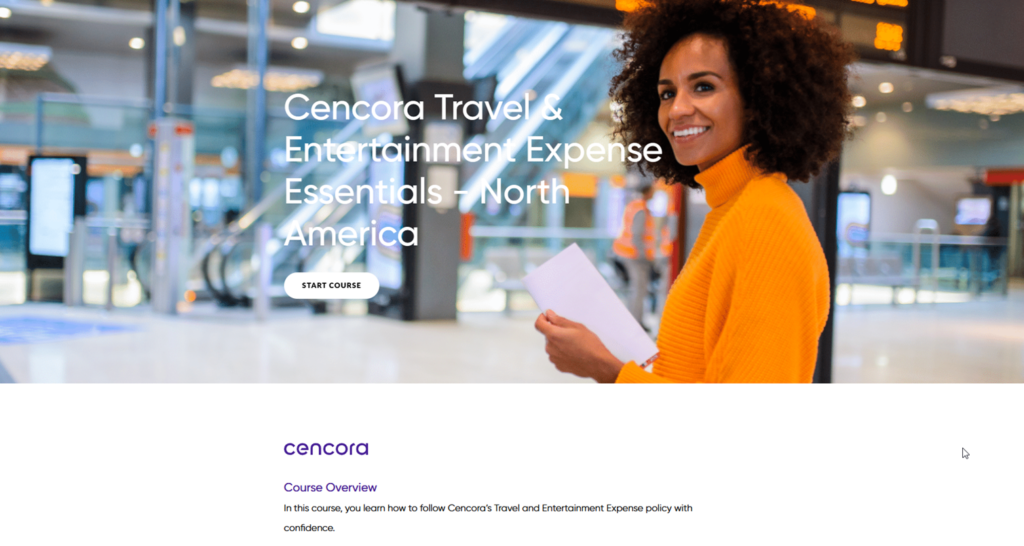
I developed the final course in Articulate Rise, integrating Synthesia videos, knowledge checks, and custom Articulate Storyline activities. Two distinct scenario experiences addressed the decisions made by individual contributors and managers.
Good, better, best — not simply right or wrong
Travel, client entertainment, and corporate spending decisions often involve gray areas. Rather than treating every situation as a binary compliance question, I designed three-choice, weighted scenarios where learners considered a good, better, or best response. Each selection provided tailored feedback explaining the reasoning behind that choice.
At the end of the scenarios, cumulative weighted scores placed learners into one of three performance-feedback categories: an excellent grasp of the material, a good understanding, or an opportunity to improve. This structure was intended to develop professional judgment and policy application, not just recall of policy language.
Results and impact
4.8/5 course rating | 2,000+ enterprise users
Following launch, stakeholders reported a significant reduction in first-submission expense-report rejections and a year-over-year reduction in corporate expenditures despite inflation.
These are stakeholder-reported business outcomes. Exact figures and analysis isolating the course’s causal contribution were not provided, so they are not presented as quantified savings or independently verified training effects.
What this demonstrates
This project reflects my approach to enterprise learning: translate complex policy into relevant job decisions, select tools for instructional purpose, tailor practice to different audiences, and use feedback to help learners exercise better judgment.